Data Science Certification Course

Ratings: 4.9 - 2,567 reviews
Rated 5 out of 5

Data Science Online Training at CourseJet helps learners develop skills in data analysis, statistical modelling, machine learning and predictive analytics. This 100% live online instructor-led programme introduces Python, SQL, Pandas, NumPy, Matplotlib, Seaborn and Scikit-learn, alongside essential concepts in statistics and data visualisation. Learners explore data cleaning, exploratory data analysis, feature engineering, regression, classification, clustering and model evaluation. The training focuses on understanding how organisations transform raw data into useful insights and build predictive models to support business decisions. CourseJet's interactive online sessions provide opportunities to discuss practical datasets, understand analytical workflows and clarify technical questions directly with an instructor. The programme is suitable for aspiring data scientists, data analysts, software developers, IT graduates and professionals seeking to strengthen their analytical capabilities. It supports professional development in programming, statistical reasoning, machine learning and data-driven problem-solving.

2765+

Total Learners

30 Hrs

Course Duration

15 Hrs

Assignments Duration

100%

Job Oriented Training

24/7

Students Support

CourseJet's Training Modes

Learn from World’s top Data Science Certified faculty and industry leaders

Online Batch Training

One To One Training

Customized Training

Fast Track Training

Corporate Training

Upcoming Batch Schedule

Check out our Data Science online certification batch timings. Does this batch not suits your timings? No worries, we will customize and arrange the batch timings that match you perfectly to your interest.

16-11-2026

Weekdays Regular (Class 1Hr - 1:30Hrs) / Per Session. (Monday - Friday) Time: 08:00 AM (IST)
WEEK DAY

21-11-2026

Weekend Regular (Class 3Hrs) / Per Session. (Saturday - Sunday) 11:00 AM (IST)
Week End

19-11-2026

Weekdays Regular (Class 1Hr - 1:30Hrs) / Per Session. (Monday - Friday) Time: 08:00 AM (IST)
WEEK DAY

22-11-2026

Weekend Regular (Class 3Hrs) / Per Session. (Saturday - Sunday) 11:00 AM (IST)
Week END

16-11-2026

Weekdays Fast-track (Class 3Hrs - 4Hrs) / Per Session. (Monday - Friday) 10:00 AM (IST)
FAST TRACK

21-11-2026

Weekend Fast-track (Class 5Hrs - 6Hrs) / Per Session. (Saturday - Sunday) 11:00 AM (IST)
Fast Track

Can’t find a batch you were looking for?

Get Flexible Batch Timings according to your Interest 

Best Data Science Certification Course Online

Data Science Certification Training Online introduces the methods, programming tools and analytical techniques used to extract meaningful information from structured and unstructured data. Data science combines statistics, mathematics, computer programming and domain knowledge to identify patterns, develop predictive models and support evidence-based decisions. Python is widely used for data science because of its extensive analytical ecosystem. Libraries such as Pandas and NumPy support data manipulation and numerical computing, while Matplotlib and Seaborn provide tools for visualisation. Scikit-learn supports common machine learning algorithms, preprocessing techniques and model evaluation.

Important concepts include descriptive statistics, probability, hypothesis testing, data preprocessing, feature selection, supervised learning, unsupervised learning and predictive modelling. SQL is also valuable for retrieving and analysing information stored in relational databases. Data science is applied in banking, healthcare, retail, manufacturing, telecommunications and technology. Common applications include customer segmentation, fraud detection, demand forecasting, recommendation systems and operational analysis. CourseJet’s live online instructor-led training helps learners understand analytical workflows, Python programming, statistical methods and machine learning techniques. The programme supports professional development for individuals interested in data science, machine learning, business analytics and related technical careers.


Benefits of Learning Data Science at CourseJet

Looking for Hands-On Training?

Get Practical Assignments and Real time projects

Drop us a Query

About Data Science Course

The Data Science Online Course introduces the principles, technologies and analytical methods used to extract knowledge from data. Data science involves collecting information, preparing datasets, applying statistical techniques, developing predictive models and interpreting results to support business and technical decisions. A typical data science workflow begins with problem definition and data collection. Information may originate from relational databases, spreadsheets, application logs, APIs or other sources. Python libraries such as Pandas and NumPy help analysts clean missing values, transform variables, combine datasets and perform numerical operations. SQL supports data extraction and database queries.

Exploratory data analysis uses statistical summaries and visualisations to investigate distributions, relationships, unusual observations and potential data quality issues. Statistical methods, including probability distributions, correlation analysis, confidence intervals and hypothesis testing, provide a foundation for interpreting data and evaluating assumptions. Machine learning introduces algorithms that identify patterns and generate predictions.  Supervised learning includes regression and classification, while unsupervised learning includes clustering and dimensionality reduction. Model development involves feature engineering, training and validation datasets, cross-validation, performance metrics and overfitting prevention.

Data science supports applications such as customer behaviour analysis, credit risk assessment, medical research, inventory forecasting and recommendation systems. Learners can develop knowledge of programming, statistical reasoning, predictive modelling and analytical communication. These skills are relevant to organisations seeking reliable insights from complex datasets.

The primary objective of Data Science Online Training is to help learners understand how to collect, analyse, interpret and model data using programming, statistics and machine learning techniques.

The programme introduces analytical problem-solving, data preparation, statistical analysis and predictive modelling. Learners can develop the following technical capabilities:

  • Understanding Data Science Fundamentals: Learn the stages of the data science lifecycle, including problem definition, data collection, analysis, modelling and interpretation.
  • Developing Python Programming Skills: Understand Python syntax, variables, functions, data structures and programming techniques relevant to analytical tasks.
  • Performing Data Manipulation: Explore Pandas and NumPy for cleaning datasets, transforming variables, handling missing values and performing numerical calculations.
  • Applying Statistical Methods: Learn descriptive statistics, probability, hypothesis testing, correlation analysis and statistical inference.
  • Creating Data Visualisations: Understand how Matplotlib and Seaborn support exploratory analysis and communication of analytical findings.
  • Developing Machine Learning Models: Explore regression, classification, clustering and common algorithms implemented using Scikit-learn.
  • Evaluating Predictive Models: Learn about training and testing datasets, cross-validation, accuracy, precision, recall, F1-score and regression error metrics.
  • Understanding Responsible Data Science Practices: Develop awareness of data leakage, model bias, privacy considerations, reproducibility and appropriate interpretation of model results.

These objectives support technical development for aspiring data scientists, analysts and machine learning professionals.

Learning data science can help professionals develop technical skills in programming, statistics, data analysis and predictive modelling. Data science knowledge is relevant to career pathways such as Data Analyst, Junior Data Scientist, Machine Learning Engineer, Business Intelligence Analyst and Analytics Consultant.

Organisations use analytical technologies to understand customer behaviour, forecast demand, assess risk and improve operational decisions. Professionals who can prepare datasets, evaluate statistical relationships and develop predictive models can contribute to these activities. Software developers can expand their expertise into machine learning, while business analysts and database professionals can strengthen their quantitative capabilities.

Combining Python, SQL, statistics, machine learning and domain knowledge can broaden professional opportunities. Career progression depends on technical competence, practical experience, communication skills and employer requirements. Learning data science provides a foundation for continued development in analytics, artificial intelligence and related disciplines.

CourseJet’s Data Science Online Course is suitable for individuals interested in statistical analysis, programming, predictive modelling and data-driven decision-making.

The programme may benefit the following learners:

  • Aspiring Data Scientists: Individuals interested in statistical modelling, machine learning and predictive analytics.
  • Data Analysts: Professionals seeking to expand their skills beyond descriptive reporting into predictive analysis.
  • Software Developers: Programmers interested in Python-based analytics and machine learning applications.
  • Business Analysts: Professionals who want to strengthen their statistical reasoning and data interpretation skills.
  • Database Professionals: SQL developers and database specialists interested in analytical modelling.
  • Engineering Graduates: Learners exploring technical careers involving programming, mathematics and data analysis.
  • Finance Professionals: Individuals interested in risk analysis, forecasting and quantitative decision-making.
  • Marketing Analysts: Professionals seeking to understand customer segmentation, campaign analysis and predictive modelling.
  • IT Graduates: Learners exploring entry-level opportunities in data analytics and data science.

Beginners can start learning data science fundamentals without previous professional experience in analytics. However, basic computer knowledge and an interest in mathematics and problem-solving are recommended. Familiarity with algebra, descriptive statistics and logical reasoning helps learners understand analytical concepts. Previous programming experience is useful but not essential for introductory Python topics.

Knowledge of SQL, spreadsheets or databases can also support data preparation and analysis. More advanced machine learning topics require a stronger understanding of probability, statistics, linear algebra and programming. Learners should confirm the required Python version, development environment, software packages and system specifications with CourseJet before enrolling.

CourseJet provides Data Science Online Training in small batches of 2 to 3 learners. This approach supports direct interaction with the instructor and allows participants to clarify technical questions during live online sessions. Smaller groups encourage focused discussions about Python programming, statistical concepts, data preprocessing, machine learning algorithms and model evaluation.

CourseJet also offers one-to-one instructor-led training for learners who prefer individual attention and personalised explanations. Participants can enquire about available batches, individual training arrangements and suitable session timings before enrolling. Training schedules depend on instructor availability and confirmation.

Launch your dream career Now!

Get personalized career coaching & mentors from industry

Data Science Course Curriculum

Our Data Science Course Curriculum encompasses all the course modules with a clear description and the concepts covered in each module. CourseJet designs the syllabus in the learner's perspective to provide comprehensive knowledge.

Data can be defined as a collection of facts like numbers, measurements, words, etc. In the technical sense, data can be defined as a collection of quantitative or qualitative variables. A datum is a single unit of a single variable. Everything that we work completely deals with data and the data is everywhere. It is considered as the most important element because it exists everywhere.

Topics Covered in this module are:

  •  What is Data?
  • Types of Data
  • Types of Data Collections
  • Different forms of sources and Data
  • The architecture of Data and its components
  • OLAP vs OLTP
  • How to structure large amounts of data and store it

Big Data is a field that mainly deals with large volumes of data. You will find lots of data to analyze, process, and extract. You will find many new ways to organize large amounts of data. It finally leads to the best strategic business moves. Big Data describes both structured and unstructured data.  

Topics Covered in this module are:

  • Introduction to Big Data
  • Big Data Architecture
  • Distributed Computing and Complexity
  • Hadoop Introduction
  • Hadoop Ecosystem
  • Map Reduce Framework

Data Science is a field of study that makes use of scientific processes, methods, systems, and algorithms to extract insights from nonstructural and structural data. This field is mainly related to Big Data and Data Mining. The Data Science field is mainly used to solve analytically complex problems.

Topics Covered in this module are:

  • Data Science Life Cycle
  • Data Analysis and Business Intelligence
  • Types of Analytics
  • Foundation of Data Science
  • Data Acquisition
  • Need for Data Science
  • Data Transformation
  • Applications of Data Science
  • Resolution Techniques
  • Big Data and Hadoop
  • Introduction to R programming, Deep Learning, and Machine Learning
  • Data Science Use Cases

R is one of the most prominently used programming languages in the field of Data Science. It provides a friendly environment for statistical computing. This language is most widely used by data miners and statisticians. This language is frequently used for data analysis. Furthermore, it is used to develop statistical software. 

Topics Covered in this module are:

  • R programming Introduction
  • Analytics Concepts
  • Usage of R in Industry
  • Installation of R and other packages
  • Performing R operations using Command Line
  • R studio
  • Importance of R in Analytics

In this module, you will get in-depth knowledge of Data import techniques in R programming. You will also learn how to import data in R to a simple text file. 

Topics Covered in this module are:

  • Techniques to import data in R programming
  • Data import using Statistical methods
  • Installation of Packages required for Database Import
  • How to establish an RDBMS connection with R using ODBC
  • Web Scraping

Data Exploration is one of the key essentials in Data Science. It is an approach that is quite similar to data analysis. The Data Analysts make use of visual exploration to understand what is present in the dataset and data characteristics. Data Exploration technique helps the users build familiarity with the existing information to find better answers in simpler ways.

Topics Covered in this module are:

  • What is Data Exploration
  • Importance of Data Exploration
  • Data Exploration using R
  • Data export from external sources
  • Data Frames
  • User-defined functions
  • Data Import and Export
  • Looping Statements 
  • Accessing Individual Elements

Data Manipulation in R is defined as a process of modifying data to make it easier to read and more organized. The data is manipulated mainly for visualization and analysis. Data manipulation plays a major role in Data Exploration, it helps in organizing data using available sets of variables. Different data manipulation functions are used to manipulate data in R programming.

Topics Covered in this module are:

  • How to manipulate Data
  • Various phases of Data Cleaning
  • Data Cleaning Techniques
  • Functions used in the inspection
  • Methods used for Data Manipulation in R

Data Visualization is considered as one of the beautiful arts to turn numbers into useful information or knowledge. R programming provides built-in functions and libraries to build visualizations and present data in a well-organized format. 

Topics Covered in this module are:

  • What is Data Visualization
  • Key elements used in Data Visualization
  • Graphics Introduction
  • Bar-plots for categorical variables
  • ggvis package
  • Visualization using ggvis package
  • Building web applications with shinyR
  • Data Visualization vs Infographics
  • Various GUIs
  • Graphical functions in R
  • Histogram and various density plots

EDA is abbreviated as Exploratory Data Analysis is a process of visualizing and analyzing data to get better insights from it. Various steps are included in performing EDA in R programming such as import data, clean data, process data, and visualize data. 

Topics Covered in this module are:

  • Introduction to EDA
  • Different types of EDAs
  • Goals of EDA
  • The need for EDA in Data Science
  • EDA Implementation
  • Various EDA functions
  • Use-cases for EDA using R
  • Multiple packages for data analysis

Hadoop is the collection of open-source software utilities that can be facilitated using a network of a number of computers to solve problems that involve a massive amount of computation and data. This provides a software framework for distributed storage. It is designed and developed by Apache Software Foundation. 

Topics Covered in this module are:

  • Hadoop Architecture
  • Why Hadoop
  • Hadoop vs Traditional Approach
  • Distributed Model
  • Use-cases of Hadoop
  • Hadoop EcoSystem
  • Hadoop FUndamental Design Principles
  • Hadoop vs RDBMS
  • Hadoop Cluster
  • Writing and reading files to and from HDFS

MapReduce is a programming model that is mainly designed to process a large volume of data parallelly by dividing the whole work into a set of independent tasks. The user expresses the algorithm in two functions Map and Reduce. The Map function is only applied to the input data and mainly used to produce a list of intermediate pairs.

Topics Covered in this module are:

  • Introduction to MapReduce
  • The need for MapReduce 
  • various concepts of MapReduce
  • Log Processing
  • Word Count Problem

MapReduce is a programming model that is mainly designed to process a large volume of data parallelly by dividing the whole work into a set of independent tasks. The user expresses the algorithm in two functions Map and Reduce. The Map function is only applied to the input data and mainly used to produce a list of intermediate pairs.

Topics Covered in this module are:

  • What is Partitioner?
  • What is Combiner?
  • Counter
  • I/o formats
  • Map Join using MR
  • Reduce Join using MR
  • Distributed MR Cache
  • Planning for cluster
  • Hadoop Configuration

Statistics is the defined form of mathematical analysis that mainly uses representations, synopses, quantified models for real-life case studies or sets of experimental data. Statistics mainly deals with the study of the methodologies to gather, analyze, review, and derive a conclusion from the given data. There are various statistical measures like Mean, Median, etc.

Topics Covered in this module are:

  • The need for Statistics
  • Different Categories of Statistics
  • Different types of data
  • Correlation
  • Covariance
  • Normalization
  • What is Probability?
  • Binary Distribution 
  • Normal Distribution
  • How to build a statistical analysis model
  • Sampling
  • ANOVA
  • What is Regression?

The term Machine Learning is defined as a scientific study of statistical models and algorithms that are mainly used by computer systems to perform different tasks without using explicit instructions. Machine Learning is considered as a subset of Artificial Intelligence.

Topics Covered in this module are:

  • Why the trend for Machine Learning is rising
  • Clustering
  • Machine Learning Fundamentals
  • Machine Learning Use Cases
  • Clustering
  • Decision Tree Classifier
  • Naive Bayes Classifier
  • K-Means Clustering
  • Predictive Models
  • Linear Regression
  • Random Forests
  • Similarity Metrics
  • Sentimental Analysis
  • Logistic Regression

Python is a general-purpose, interpreted, object-oriented programming language. It is the easiest programming language to learn and code programs. Top technology trends like Artificial Intelligence, Data Science, Deep Learning, Machine Learning, and many more. Python is the most widely used programming language across many organizations. 

Topics Covered in this module are:

  • What is Python Programming
  • History of Python
  • Installation of Python
  • Environmental Setup
  • Python Syntax
  • Key Features of Python
  • Key fundamentals of Python
Python is a general-purpose, interpreted, object-oriented programming language. It is the easiest programming language to learn and code programs. Top technology trends like Artificial Intelligence, Data Science, Deep Learning, Machine Learning, and many more. Python is the most widely used programming language across many organizations. Python is the most prominently used language by the data scientist for designing and developing Data Science applications. Most libraries are provided to develop Data Science applications.

Topics Covered in this module are:

  • Why Python
  • Introduction to Data Science
  • List of areas in which Python programming is used in the field of Data Science
  • Developing Data Science applications using Python
  • Libraries for developing Data Science Applications

The term Machine Learning is defined as a scientific study of statistical models and algorithms that are mainly used by computer systems to perform different tasks without using explicit instructions. Machine Learning is considered as a subset of Artificial Intelligence. It mainly makes use of python programming to focus on the development of new programs that can be changed when exposed to new data.

Topics Covered in this module are:

  • Machine Learning Introduction
  • Why Python?
  • NumPy and Scipy
  • Matplotlib and its use
  • Machine Learning Applications
  • Supervised vs Unsupervised Learning
  • Usage of Python Programming in Developing Machine Learning Applications

Supervised Learning is a Machine Learning task. It is a process of learning i.e., the process of mapping the input data based on the given input and output example pair. In this Supervised Learning process, the input data is provided to map it with the desired output. The example will be provided for the user to get a clear idea about mapping elements and they proceed according to it. Here you need to supervise the model using given input and output data.

Topics Covered in this module are:

  • Classification Problem
  • K-Nearest Neighbouring Problem

Unsupervised Learning is a Machine Learning technique. In this, you need not supervise the given model. In this Learning process, you need to work on your own. It provides a platform for you to learn on your own and discover desired information. It completely deals with labeled data. You will not be provided with any kind of input or output data and also no examples are provided to work. You need to research on your own and perform whatever you want to get the desired output.

Topics Covered in this module are:

  • Introduction to Unsupervised Learning
  • Clustering and its types
  • Clustering Algorithms
  • K-means in Scree-plot Dendrogram
  • Hierarchical Clustering
  • PCA in R
  • Implementation of PCA

All the above concepts will be covered in Our Data Science Course. You will become a master in all the concepts of Data Science because our trainers will make you learn very effectively. Our main goal is to make students satisfied with the training and place them in the top companies.

Like the Course Curriculum?

Or need customized syllabus? Enroll Now & personalized it!

Data Science Course Features

CourseJet offers the best Data Science online training with advanced features. Our world-class features will provide zeal for the learners to enroll for top training courses.

Instructor-led Sessions

30 to 45 Hrs of Data Science Online Live Instructor-Led Classes.

Expertise Faculties

Our Faculties are working Data Science Professionals in MNC Companies.

Certification & Job Assistance

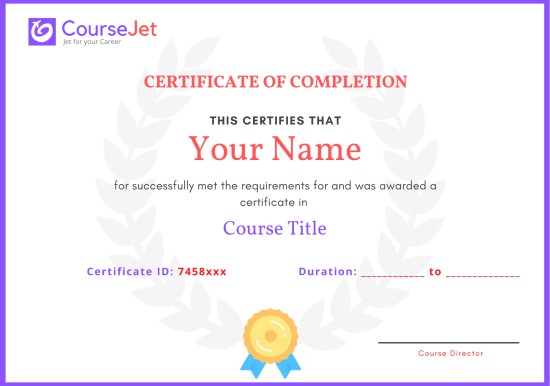
After Successful completion Data Science course you will receive Globally Recognized CourseJet Certificate.

100% Job Oriented Training

Data Science Live project based on any real time scenarios.

Lifetime Access

You get lifetime access which includes Data Science class recordings and Materials.

Flexible Schedule

We will provide you Convenient Class Batches with lifetime access to our 24x7 online support team.

Data Science Certification Training

Get the Globally Recognized Data Science certification training from CourseJet under the guidance of Data Science Experts. CourseJet teaches you all the Data Science concepts with global standards.

certificate

Data Science Certification Training Online helps learners develop knowledge of programming, statistical analysis, machine learning and predictive modelling relevant to professional development and certification preparation. Data science does not have one universal certification authority. Instead, several technology providers offer credentials related to machine learning, artificial intelligence and data analytics. Examples of established certification pathways include the Google Cloud Professional Machine Learning Engineer and AWS Certified Machine Learning Engineer – Associate credentials.

These certifications focus on their respective cloud platforms and assess skills beyond introductory data science. Relevant certification topics may include data preparation, feature engineering, model training, evaluation, deployment, monitoring and responsible machine learning practices. CourseJet’s live online instructor-led training helps learners develop foundational knowledge of Python, statistics, machine learning algorithms and analytical workflows.

However, cloud-specific certifications require additional knowledge of the relevant provider’s infrastructure, tools and services. Learners should review current examination objectives, eligibility conditions and registration requirements before choosing a certification pathway. A CourseJet course completion certificate, where available, is separate from an official professional certification issued by an external provider. Completing CourseJet’s Data Science training does not automatically award a third-party credential or guarantee examination success.

CourseJet’s Data Science Certification Programme provides structured learning for individuals interested in programming, statistical analysis and machine learning. The programme introduces Python, Pandas, NumPy, SQL, statistical methods, data visualisation and predictive modelling concepts. These technologies help learners understand how data is prepared, analysed and used to develop models that support business decisions.

Live online instructor-led sessions provide opportunities to clarify technical questions and discuss analytical scenarios. The training can help aspiring Data Scientists, Data Analysts and software professionals strengthen their understanding of data science methods. Learners pursuing external machine learning or analytics certifications should compare the course topics with the current examination objectives of their chosen certification provider. CourseJet’s programme focuses on technical understanding and professional skill development without guaranteeing certification success.

CourseJet’s Data Science course completion certificate, where available, documents participation in or completion of the institute’s training programme according to its applicable requirements. Learners should confirm whether certificate eligibility depends on attendance, completion of technical exercises, assessments or other conditions. Certificate eligibility and assessment requirements: Confirm CourseJet Certificate Requirements. A CourseJet completion certificate is different from a professional certification issued by an external technology provider.

Official third-party credentials require candidates to meet the examination and certification requirements established by the relevant organisation. Completing CourseJet’s Data Science Online Training does not automatically award an external professional certification. Learners should verify certificate arrangements and any applicable assessment requirements before enrolment.

A CourseJet Data Science course completion certificate, where issued, can document participation in training covering Python programming, statistics, machine learning and analytical methods. However, a training provider’s completion certificate should not be presented as an internationally accredited professional qualification without supporting evidence. Employers may consider training certificates alongside technical assessments, programming ability, statistical knowledge and practical analytical experience.

CourseJet-specific external accreditation or international recognition: Confirm Accreditation or Recognition Status Professional credentials issued by established technology providers are separate qualifications with their own examination and verification requirements. Learners should verify the recognition and validity of any credential directly with its issuing organisation. Demonstrating practical knowledge of data preprocessing, statistical analysis, predictive modelling and model evaluation remains important when pursuing data science-related professional opportunities.

Get personalized 1-1 course consultation

Career-Focused Course Material and Personal Coaching to get Job.

Data Science Projects

CourseJet not only provides you with the best Data Science training but also makes you work with real-world projects and case studies to help you gain practical knowledge.

  • Practical knowledge is very important to understand how things actually work. To put your all learning into action, you will be required to work on two industry-based live projects that will discuss the real-time use cases.
  • CourseJet Data Science Training will help you gain in-depth knowledge of all the essential concepts of Data Science through real-world examples and hands-on projects.
  • We make each and every individual work on Data Science real-time projects to face challenges during the learning period so it will be very helpful to solve problems arising in organization while in the job.
  • Working with real-time projects will make more efficient and you will get more doubts. This type of working procedure will help you achieve a lot more things in your career.

Industry: Insurance 

Project Description: This project is mainly designed to conduct predictive analysis of available data and to find out which insurance policy is best suitable for a particular age group. You can suggest the best policy scheme for your colleagues.

Topics that will be covered in this project are:

  • Statistical analysis
  • Association rule
  • Collaborative user-based filtering
  • Statistical analysis
  • Recommendation engine

Industry: Retail

Project Description: This project will help you gain practical knowledge on how to analyze customer behavior. Every customer will have different tastes in making purchase decisions. You can segregate your customer behavior under different categories. Based on their behavior and their opinion of choice you can predict whether they are going to buy or not.

Topics that will be covered in this project are:

  • Classification trees and decision trees
  • K-means clustering
  • Apriori algorithm and its deployment procedure in R
  • Association rule mining

Develop a professional portfolio Now!

Complete real-time projects, to showcase your skills to employers.

Data Science Trainer Profile

You will learn the Data Science essentials from the expert’s trainers who hold 10+ years of real-time experience in handling diversified projects.

10+ Years Experienced

Our Data Science Trainers are more than 10+ Years of experience.

Working in Top MNCs

Our Data Science Trainers are Working in a top MNC company around the globe.

Trained 2000+ Students

Our Data Science Trainers are Trained more than 2000+ Students in Data Science Courses.

Certified Professionals

Our Data Science Trainers are certified Data Science Professionals with Strong Practical Knowledge.

Certification Guidance

Our Data Science Trainers will help you in getting International Certification if available.

Completed 700+ Batches

In CourseJet, we already finished many batches successfully with certifications.

Talk to our course Trainer now

Enroll now and get a free consultation with the trainer.

Data Science Training Reviews

Our Best Data Science Teaching methodology has acquired millions of students around the globe and they shared their success stories in the form of reviews.

✎ 2567
Total Reviews
✪ 4.9
Review score
✉ 99%
Course Completions

Data Science Jobs & Placements

CourseJet has tie-up with small, medium, and large scale corporations across the world. We provide you with the complete placement assistance by forwarding your resume to the companies we tie-up with.

Data science skills are relevant to professional opportunities involving data analysis, predictive modelling, statistical research and business intelligence. Organisations in banking, healthcare, retail, manufacturing, telecommunications, finance and technology use data science to investigate business performance, identify patterns, forecast outcomes and support operational decisions.

Professionals with data science knowledge may explore positions such as Data Analyst, Junior Data Scientist, Machine Learning Engineer, Business Intelligence Analyst, Analytics Consultant and Statistical Analyst. Employers may seek expertise in Python, SQL, Pandas, NumPy, statistical analysis, data visualisation, machine learning algorithms and model evaluation.

CourseJet’s live online instructor-led training helps learners understand analytical concepts and common data science workflows. Developing knowledge of data preparation, exploratory analysis, predictive modelling and statistical interpretation can support professional development and technical interview preparation. CourseJet placement assistance, interview preparation, CV guidance, career mentoring and job opportunity updates: Confirm Available Career Support Services

Learners should enquire about the career-related services included in their training programme. Employment opportunities depend on technical competence, practical experience, qualifications and employer requirements. Familiarity with cloud computing, data engineering, software development and domain-specific analytical techniques can provide additional value when exploring data science positions

CourseJet’s Data Science Online Training focuses on developing technical knowledge of Python programming, statistical analysis, data manipulation and machine learning. The availability and scope of formal placement assistance should be confirmed directly with CourseJet before enrolment. Placement assistance details: Confirm Placement Assistance Services. Learners can enquire whether interview preparation, CV guidance, career mentoring or information about relevant data science vacancies is included in the programme.

Preparing for data science interviews may involve reviewing Python, SQL, probability, statistics, exploratory data analysis, machine learning algorithms and model evaluation techniques. Demonstrating analytical reasoning, programming ability and an understanding of statistical assumptions can support recruitment preparation. CourseJet training does not guarantee employment, as hiring decisions depend on employer expectations and individual qualifications.

Learning data science can help individuals develop skills relevant to data analysis, statistical modelling and machine learning. However, completing a training programme alone does not guarantee employment. Beginners with suitable programming and analytical knowledge may explore junior data analysis, reporting or entry-level analytics positions, depending on employer requirements. Experienced software developers, statisticians and analytics professionals may be better positioned to pursue Data Scientist, Machine Learning Engineer or Analytics Consultant roles.

Employers commonly assess candidates’ understanding of Python, SQL, data preprocessing, probability, statistics, machine learning algorithms and model evaluation. Learners can strengthen their recruitment readiness by analysing datasets, developing predictive models, documenting analytical decisions and reviewing technical interview questions. Combining data science expertise with cloud computing, data engineering, software development and domain knowledge can support broader professional opportunities.

Salaries for data science professionals vary according to country, city, employer, experience, technical specialisation and job responsibilities. Entry-level Data Analysts and Junior Data Scientists generally have different compensation expectations from experienced Data Scientists, Senior Machine Learning Engineers and Analytics Consultants. Professionals responsible for advanced predictive modelling, production machine learning systems, statistical research and large-scale analytical infrastructure may have different earning potential from those performing introductory data analysis tasks.

Expertise in Python, SQL, statistics, machine learning, cloud platforms and data engineering can influence compensation. Employers may also consider educational qualifications, industry knowledge, communication skills, project responsibilities and experience delivering analytical solutions. For reliable salary comparisons, candidates should review current job advertisements and established compensation research for their preferred location and role. No verified location-specific salary figure is included here. Learners should compare compensation information using consistent currencies, experience levels and reference periods before establishing realistic salary expectations.

Get your dream job in a month

Join the program to meet the Industries recruitment process

FAQ of Data Science Training

CourseJet FAQs are designed to clear most of your doubts and also help you build power in yourself to get clarified with the rest of doubts related to that course.

Yes, We offering group discounts when you join as more than three people 10% to 30% Price discount will be provided. We also have a referral discount for those who have already enrolled in our training. Terms and conditions apply.

Yes, we will share sample recordings of this course which was recorded during the live class. It will give you a good idea about the classes and the training sessions. 

You need not worry if you miss a class because CourseJet provides live recordings of the sessions so that you can go through them just before you attend the next session. If it is one to one training classes then will be rescheduled at your convenience. 

CourseJet is the Best Online Training platform, it provides high-class services for the learners. CourseJet provides Job Assistance for the learners and also helps them in getting placed in top MNCs around the world. CourseJet offers 24/7 support, best course material, and videos.

The different modes of training offered by CourseJet are as follows:

  • Instructor-led training
  • Corporate training
  • Self-paced training

Upon successful completion of this training, you will receive Course Completion Certification from CourseJet. It is a Globally Recognized Certification in top MNCs across the world. CourseJet certification is also recommended by top experts.

Yes, CourseJet provides 100% job assistance for the learners to help them get placed in top MNCs. Our trainers will help to create perfect resumes, will share the top interview questions, tutorials and necessary software installation guides.

CourseJet Job assistance program will train you to achieve your dream job by referring your resume to tied up companies and also assisting with preparing your resumes and providing important interview questions. We will help you in the all dimension between you and recruiters companies and the final selection decisions is always depends on the recruiter by the candidate’s performance in the interview. 

Yes, it is possible by paying some extra charges and can continue learning the course from the next batch.

The system requirements required to attend this training are:

  • An operating system such as Mac OS, Windows, Linux.
  • 4 GB RAM
  • Dual-core CPU

We are Experts in corporate training by Upgrading your team member’s skills. So, please get in touch with our team through fillup the corporate training Form or contact us via our Mail Id or Phone. 

Payments can be made using any of the following options like Debit Card / Credit Card, American Express, Master Card, or PayPal and a receipt of the same will be issued to you automatically via email. 

Looking for Group Discounts?

Enroll now and get a group discounts upto 30%

Related Courses

CourseJet provides training for a large number of courses. We have more than 250+ courses on our website and also provide assistance for the participants in suggesting the best training course.

© 2026 Digivigor Pvt. Ltd. All rights Reserved. The certification names are the trademarks of their respective owners. All trademarks are properties of their respective owners. View Our Disclaimer for more details. 

🚀Fill Up & Get Free Quote